Michter’s Distillery – One to Watch
 Bourbon is all about the taste. But it’s also about the story behind what makes the taste. And that’s specially true with Michter’s Distillery’s bourbons. We visited Michter’s new facility in Louisville, KY on a bright day in May expecting a tour of the building and a taste of their products. Of course I’d sampled their Michter’s Small Batch US*1 Bourbon and Rye on a few occasions, so wasn’t expecting many surprises. I was terribly wrong in my assumptions.
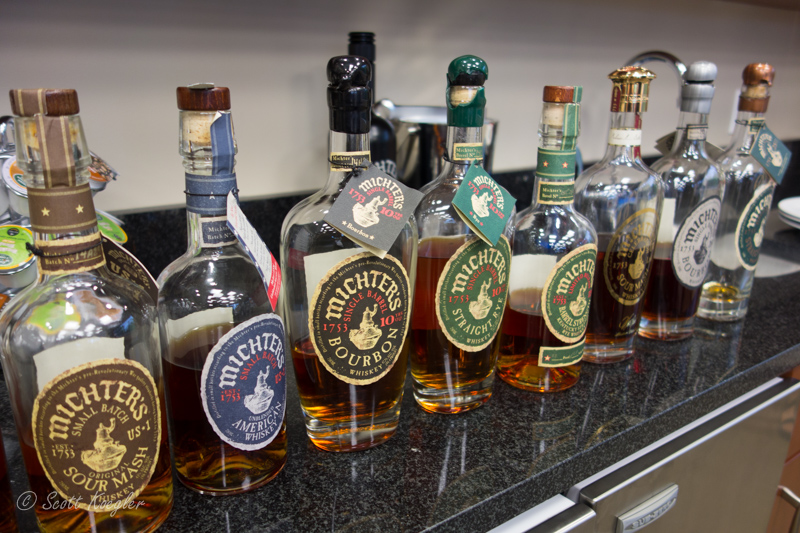
Michter’s president, Joseph Magliocco lead us to their conference room where many more bottles were displayed than I had known existed. In addition to the names we already knew there were multiple blends and ages that I’d never seen (or tasted) before.
The Leadership Team
A significant part of Joe’s plan is to assemble a stellar group of people to handle the creation of Michter’s products.
Willie Pratt, Michter’s master distiller started his career at age 18 and retired from Brown Forman but Joe convinced him to come back to help guide the overall plan.
Pam Heilmann is the company’s Distiller. She worked at as distillery manager for Booker Noe and walked us through the production facility.
Andrea Wilson is general manager for Michter’s and was previously director of operations for Diagio of North America and the first woman to serve as chair for the Kentucky Distillers Association.
Joe explained the history of Michters. The brand had its origins in 1753 in Shakersstown, PA under the name of Shank’s. Because rye was the predominant local crop, it distilled a rye whiskey. That made Shanks is the first American whiskey. In the 1950s Lou Forman ran the distillery and named the brand Michters after his sons; (Mich)ael and Pe(ter). So just for clarification, the pronunciation is ‘mikters’, taking the ‘k’ from Michael.
In 1989 the original Michter’s went bankrupt. When Joe set up Chatham Imports he wasn’t able to get good rye to sell. His research showed that the Michter’s brand had been abandoned so in 1990 Chatham revived the name and started creating the brand we know today. The original goal was to develop two types of whiskey and he settled on making a 10 year old Rye and a 10 year old Bourbon as their first offerings.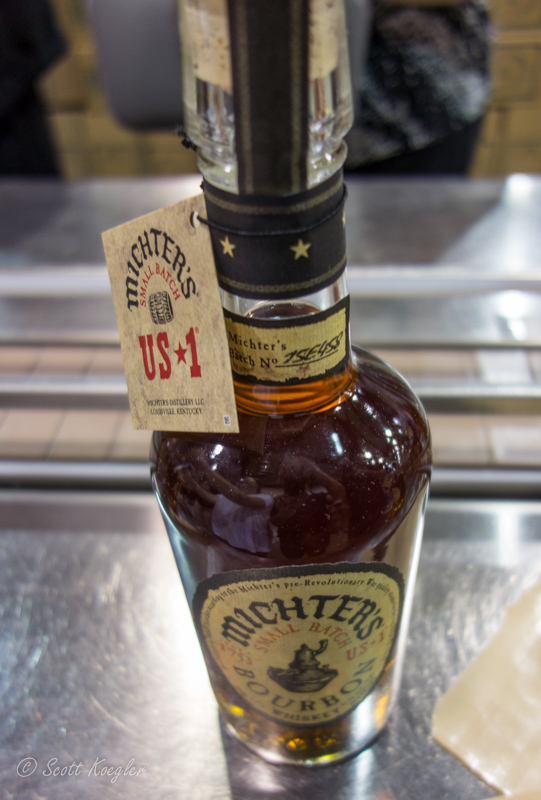
From then it took years to build the business. Joe gives a lot of credit to younger on-premise mixologists who understood that rye made really great cocktails.
The new Michter’s
First phase of production consisted of existing liquor stocks they bought based on their flavor profile. All of that whiskey came from Kentucky distilleries. The second phase of production comes from contracted distilleries who produce whiskey based on specific contracts, not just overrun stocks. The contracts specify yeast selection, mash bills, barreling at 103 proof and other specifics.
To its credit Michter’s has already racked up several impressive mentions and awards. Among them, Rob Report named it “Best American Whiskey for 2014,” Wall St. Journal said its “Rye was Phenomenal,” and Wine Enthusiast named it “Distiller of the Year.” A contributing factor is that Joe says his partners have said, “Don’t worry about costs of goods, just do everything you know to make the best whiskey you can.”
New Facilities
Now Michter’s is completing work on its own facility (the one we were touring) and it is impressive though much smaller than the giants like Wild Turkey and Brown Forman. It was not in production during our visit so we were able to see every part of the plant.
We started with the grain operation where storage and milling take place. Pam showed us the silos for corn, rye, and malt and the custom cylinder grinders that cut the grain into exactly the right sizes for each. She explained that Michter’s grinds rather than crushes its grain in order to produce consistent and controlled sizes for each. This level of control is part of what produces quality output.
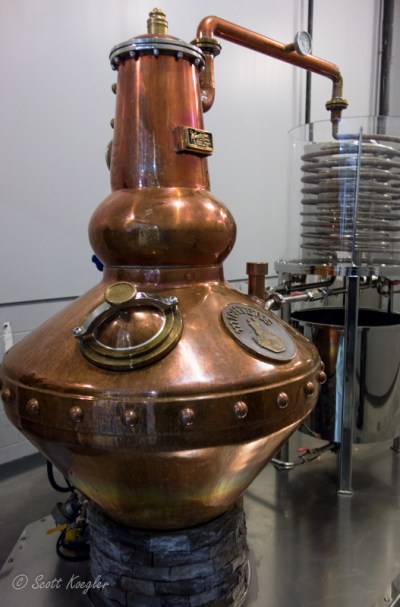
The new custom column still made by Vendome is all copper, a design that Pam explained is more costly than steel columns with copper plates. From the column still the distillate moves to the copper doubler where it is converted from about 120 proof, or low wine, to 130 to 140 proof high wine.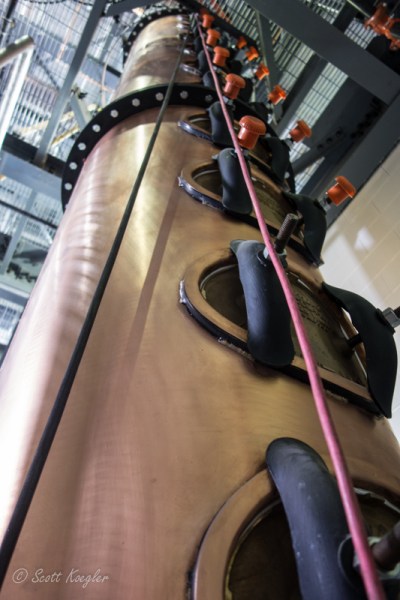
The white dog is then ready to be barreled. Willie explained, “We barrel at lower proof in barrels made of wood that has been air dried for 18 months before being toasted.” That makes their barrels more expensive than most. Joe explained, “We go the extra and barrel at 103 proof. It’s the same as the traditional method. It’s more expensive to do this because it takes more space and 25% to 30% more barrels. The whiskey is more important than the cost.” Willie put it more simply, saying, “103 proof makes the best whiskey. When it’s ready to goes to bottle it will be at about 113 proof, so less water is added to make it bottle proof.” Adding water takes away from color and flavor.
From there Andrea showed us the lab where she does the chemical monitoring for color, proof, and content. One important aspect is mouth feel. Viscosity is monitored along with all other aspects to make certain the results are as expected.
Bottling line
The bottling room was the busiest area in the facility. On the day we visited they were bottling Michter’s US*1 Bourbon. Right now there is one line, but Joe explained there is room for a second line when they need to ramp up. The bottle filler is an old design that Willie had modified to his own specifications. And the same for the labeler.
Labeling is very important to the overall process. As Joe explained, “Our inexpensive bottle retails for $48 and others for up to $4,000 per bottle. In fact that one is selling for $8900 internationally, so our packaging must be exceptional.”
Racking room
No barrels were in the barrel room yet but Willie explained his design that includes a special ventilation system to draw natural air through the facility. Willie explained, “We introduce steam heat to warm during the Winter months, then we open the vents to cool back down. In this way we let our barrels go through more heat cycles than other distillers. That means more angel’s share – as much as 60% loss. We get about 6 heat cycles per year.”
Tasting table
From there we moved back into the conference room where we were greeted with a full round of tastings ranging from standard bourbon and rye to 30 year old bourbon and rye, and a few untraditional selections including a sour mash and Michter’s Celebration Sour Mash, a special blend concocted by Willie and Joe that sells at retail for $3,500+ and even more if you can find it on the secondary market.
Michter’s is a label to watch, particularly as the new facility goes into production mode. Willie has a small experimental still to use when he wants to try a new blend. I’m particularly interested in seeing what he and the rest of the Michter’s team are able to produce in the next few years.